
What Are Hazardous Areas?
How Are They Identified and Classified?
Many industries including oil, gas, mining, resources, chemicals and processing regularly operate in environments with potentially explosive atmospheres (often called “hazardous areas”) where the risk of explosion from flammable gas / vapour or combustible dust / powder exists.
Zones
These hazardous areas are classified into different “Zones” defined by the likelihood of a potentially explosive or combustible environment existing under normal operating conditions.
Zones where potentially flammable gases or vapours exist are designated as Zone 0, Zone 1 or Zone 2 hazardous areas:
- Zone 0: An explosive gas atmosphere is present continuously or for long periods.
- Zone 1: An explosive gas atmosphere is likely to occur under normal operating conditions.
- Zone 2: An explosive gas atmosphere is not likely to occur under normal operating conditions. If it does occur, it will only exist for a short time.
Transtek supplies a range of intrinsically safe and Ex-certified devices for Zone 0, Zone 1 and Zone 2 (gas) hazardous area use:
- Zone 0 Certified Crystal XP2i Digital Test Gauge
- Zone 0 Certified Pelican 3325 Photoluminescent LED Torch
- Zone 1 Certified i.safe Mobile IS540.1 Smartphone
- Zone 1 Certified i.safe Mobile IS940.1 Android Tablet
- Zone 2 Certified i.safe Mobile IS530 Camera
- Zone 2 Certified i.safe Mobile IS930.2 Android Tablet
Zones where potentially combustible dusts or powders exist are designated as Zone 20, Zone 21 or Zone 22 hazardous areas:
- Zone 20: Combustible dusts or ignitable fibres and flyings are present continuously or for long periods.
- Zone 21: Combustible dusts or ignitable fibres and flyings are likely to occur under normal operating conditions.
- Zone 22: Combustible dusts or ignitable fibres and flyings are not likely to occur under normal operating conditions. If they do occur, they will only exist for a short time.
Transtek supplies a range of intrinsically safe and Ex-certified devices for Zone 20, Zone 21 and Zone 22 (dust) hazardous area use:
- Zone 20 Certified Emerson AMS Trex Device Communicator
- Zone 20 Certified Pelican 2690 HeadsUp Lite LED Headlamp
- Zone 21 Certified i.safe Mobile IS945.1 Windows Tablet
- Zone 21 Certified i.safe Mobile IS440.1 5G / Wi-Fi Radio
- Zone 22 Certified i.safe Mobile IS540.2 Smartphone
- Zone 22 Certified i.safe Mobile IS530 Smartphone & Thermal Camera Kit
In simplistic terms, the concept of Zones can be displayed using concentric circles. A centre circle represents Zone 0 or Zone 20 (the area where an explosive gas or dust atmosphere is present continuously or for long periods). A second circle outside Zone 0 / 20 and further removed from the hazard, represents Zone 1 or Zone 21. A third circle outside Zone 1 / 21 and further removed again from the hazard, represents Zone 2 or Zone 22.
Equipment Groups
Equipment Groups are also assigned to define the nature and general location of the hazardous material, and specify a minimum Equipment Protection Level or EPL (more on EPLs below):
- Group I: Firedamp/methane flammable gas atmospheres in underground mines.
- Group II: Explosive gas atmospheres above-ground (excludes firedamp/methane in underground mines).
- Group III: Explosive dust atmospheres.
Subgroups
Hazardous above-ground Group II gases and Group III dusts are further divided into sub-groups based on potential explosivity. Material properties such as minimum ignition energy/current, maximum experimental safety gap, flame temperature and explosion pressure are used for sub-group classification.
Gas sub-groups:
- IIA (low risk) - propane family
- IIB (medium risk) - ethylene family
- IIB+H2 (medium risk) - IIB sub-group gasses plus hydrogen
- IIC (high risk) - hydrogen and acetylene family
Dust sub-groups are classified by the material’s resistivity/conductivity:
- IIIA (low risk) - combustible fibres and flyings
- IIIB (medium risk) - non-conductive dusts
- IIIC (high risk) - conductive dusts
Transtek supplies a range of intrinsically safe and Ex-certified devices with Group I (underground mining), Group II (gas) and Group III (dust) classification:
- Group I Certified i.safe Mobile IS540.M1 Smartphone
- Group I Certified i.safe Mobile RealWear Navigator Z1 Head-Mounted Tablet
- Group II Certified Ralston FieldLab Digital Pressure Reference
- Group II Certified Pelican 2765 LED Headlamp
- Group III Certified i.safe Mobile IS540 Camera
- Group III Certified i.safe Mobile IS930.1 Android Tablet
Temperature Classifications
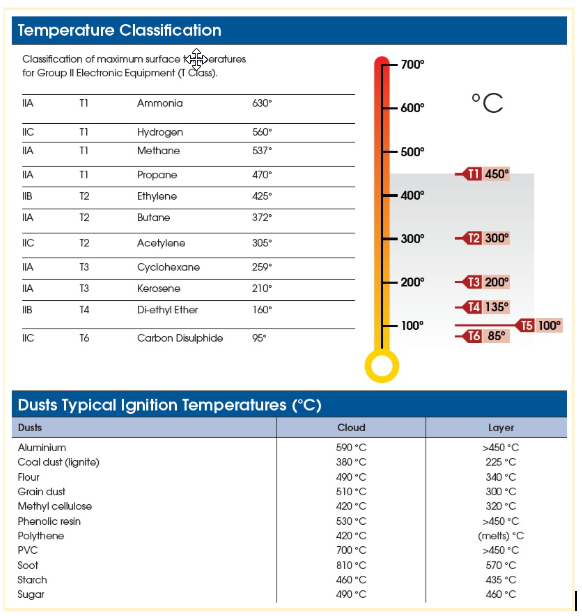
Temperature Classifications are applied to equipment according to the auto-ignition temperature of the hazardous area’s atmosphere. Equipment temperature is defined as the temperature of any unprotected surface exposed to that atmosphere.
- Equipment with Group I (underground mining) classification must maintain external surface temperatures below 150°C (for coal dust) and internal surface temperatures below 450°C (for firedamp/methane).
- Equipment with Group II (above-ground gas) classification is allocated a Temperature (T) Class range, which indicates the maximum surface temperature equipment may reach:
- T1: Maximum surface temperature <450°C (low risk)
- T2: Maximum surface temperature <300°C
- T3: Maximum surface temperature <200°C
- T4: Maximum surface temperature <135°C
- T5: Maximum surface temperature <100°C
- T6: Maximum surface temperature <85°C (high risk)
- A T6 classification restricts equipment to the lowest surface temperature and is therefore used for additional safety in areas with the greatest risk of explosion.
- It is important to note that Group II classified equipment should not be used if its surface temperature exceeds 80% of the auto-ignition temperature of the potentially explosive atmosphere. T1 <450°C classification is suitable for the 580°C auto-ignition temperature of methane but unsuitable for the 425°C auto-ignition temperature of acetylene.
- Equipment with Group III (dust) classification displays a specific surface temperature rather than a T class range; eg. T135°C rather than T4. Only external surfaces of Group III equipment are deemed unprotected if the enclosure or housing carries a suitable IP rating to protect internal surfaces against dust ingress.
Transtek supplies intrinsically safe and Ex-certified devices with a range of Temperature Classifications:
- T3 Certified Sensear SM1P-ExDP Dual Protection Headset
- T3 / T4 Certified Crystal XP3i Digital Test Gauge
- T4 Certified Crystal HPC52 Dual Range Pressure / mA Calibrator
- T6 Certified Pelican 2220 VB3 VersaBrite III Clip-On LED Light
- T135°C Certified i.safe MOBILE IS530.M1 Smartphone
- T135°C...T200°C Certified Pelican 2010i SabreLite LED Torch
Equipment Protection Levels (EPLs)
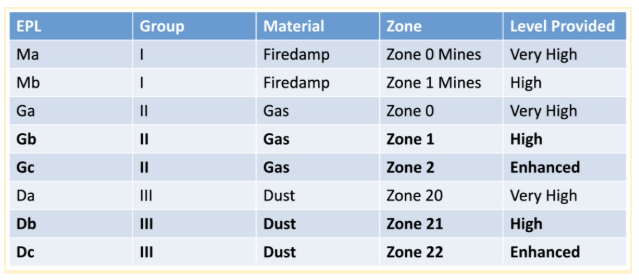
Equipment Protection Levels (EPLs) were introduced in 2009 and identify the zone in which equipment can be used.
EPLs also allow suitably qualified personnel to perform a risk assessment to determine the likelihood and potential outcome of ignition, based on the level of protection provided by equipment used in a hazardous area. This provides a means of assessing local risk and can provide a more tailored outcome than that offered by the more conventional but rigid process where Zone classification is often linked to the Protection Type or technique used to make equipment safe for hazardous area use (more on Protection Types below).
The relationships between EPLs, Groups and Zones are as follows:
- Ma - Group I (underground mining), Zone 0
- Mb - Group I (underground mining), Zone 1
- Ga - Group II (gas), Zone 0
- Gb - Group II (gas), Zone 1
- Gc - Group II (gas), Zone 2
- Da - Group III (dust), Zone 20
- Db - Group III (dust), Zone 21
- Dc - Group III (dust), Zone 22
Where equipment is assembled from Ex-certified parts with different EPLs, the final EPL rating will generally match the lowest EPL rating of the components. For example, if a tablet rated Ga (Group II, Zone 0) is housed within an enclosure rated Gb (Group II, Zone 1), the EPL rating for the device as a whole will be Gb.
Transtek supplies intrinsically safe and Ex-hazardous area approved equipment with certification covering all Equipment Protection Levels:
- Ma Certified Fluke 28 II Ex Digital Multimeter
- Ga Certified Crystal nVision Reference Recorder
- Gb Certified Crystal IS33 Dual-Range Pressure Calibrator
- Gc Certified i.safe Mobile IS120.2 Smartphone
- Da Certified Pelican 3610 Little Ed Right Angle Torch
- Db Certified Softing MobiLink Industrial Protocol Modem
- Dc Certified i.safe Mobile IS-TC1A.2 Thermal Camera Add-On
Protection Types / Methods
A number of Protection Types for electrical and non-electrical equipment are recognised and regulated by the IEC 60079 series of standards and IEC 80079-36 standard. These Protection Types offer manufacturers a choice of permitted methods to ensure their equipment is suitably “protected” when operated or installed in hazardous areas.
There are many Protection Type options available, each with their own protection concept or principle, use cases and Zone suitability. The most commonly used Protection Types for electrical equipment supplied by Transtek are as follows:
Intrinsic Safety “i” (IEC 60079:11)
- Suitable for Zone 0/20 (ia), Zone 1/21 (ib) or Zone 2/22 (ic) hazardous areas.
- Voltage and current within electrical circuits are kept so low that even if sparks, arcs or a rise in surface temperature occur, the limited energy produced is incapable of igniting an explosive atmosphere. Ex ia (Zone 0/20) certified equipment must remain operational and protected with up to two faults, Ex ib (Zone 1/21) certified equipment with one fault and Ex ic (Zone 2/22) certified equipment with no faults. During testing, faults are applied to equipment and circuit energy is measured over 1600+ make and break contacts inside a chamber filled with the most sensitive gas mixture expected in the explosive atmosphere.
Flameproof Enclosure “d or db” (IEC 60079:1)
- Suitable for Zone 0 (da, limited applications), Zone 1 (db) or Zone 2 (dc, limited applications) hazardous areas.
- A robust equipment enclosure is able to withstand an internal explosion and protect the external atmosphere from ignition. Unavoidable enclosure gaps or flame paths are lengthened and narrowed to sufficiently cool and neutralise any escaping hot gasses.
Enclosure (for Explosive Dust Atmospheres) “t or tD” (Previously DIP, IEC 60079:31)
- Suitable for Zone 20 (ta), Zone 21 (tb) or Zone 22 (tc) hazardous areas.
- The equipment enclosure is sealed so that no combustible dust can enter. The surface temperature of the enclosure is restricted for Ex tb (Zone 21) and Ex tc (Zone 22) certification, whereas the surface temperature of internal components is also restricted for Ex ta (Zone 20) certification. Ex ta (Zone 20) certification requires equipment enclosures with IP6X dust protection rating.
Optical Radiation “op” (IEC 60079:28)
- Optical radiation classification is supplementary to other electrical Protection Types. Electrical equipment using a laser, collimated light source or high power LEDs can be protected against becoming an ignition source in one of three ways:
- 1. Inherent safety “op is”. Emitted optical energy is limited and unable to ignite an explosive atmosphere. Suitable for Zone 0, Zone 1 or Zone 2 hazardous areas.
- 2. Protection “op pr”. Optical radiation is confined within a leak-free transmission medium (e.g. optical fibre). Suitable for Zone 1 or Zone 2 hazardous areas.
- 3. Interlocking “op sh”. Where radiation is not inherently safe, an interlock mechanism shuts down optical transmission when output fails to reach a receiver. Suitable for Zone 0, Zone 1 or Zone 2 hazardous areas.
Transtek’s product catalogue features a huge choice of intrinsically safe, flameproof, enclosure and optical radiation classified equipment:
IP / Ingress Protection / International Protection Ratings
Electric and electronic equipment deteriorates or malfunctions when water or dust enters the device. Ingress Protection or International Protection (IP) ratings were introduced by the IEC to “grade the resistance of an enclosure against the intrusion of dust or liquids”. These ratings are widely used throughout industry and help manufacturers define the ruggedness and suitability of equipment used in hazardous workplaces or extreme environments.
Many consumer-grade devices such as smartphones list features that include resilience against liquid and dust. However, it can be difficult to assess the meaning of general terms such as waterproof or water-resistant when used for marketing purposes.
IEC 60529 standard was developed to rate and grade the resistance of enclosures of electric and electronic devices against the intrusion of dust and liquids. The standard also rates how easy it is for individuals to access the potentially hazardous parts within the enclosure.
IEC 60529 uses IP codes to rate the degrees of protection offered by the enclosure of electrical equipment with 72.5kV maximum voltage rating. The standard also defines the tests to be performed to verify that the enclosure meets these requirements.
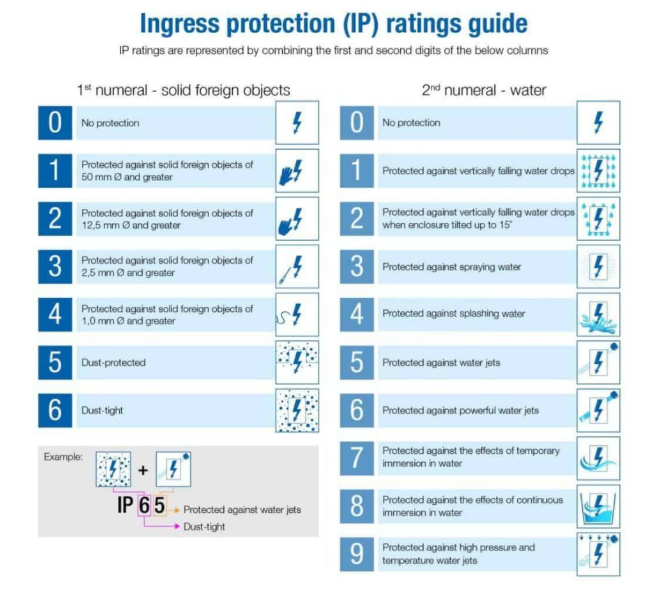
An IP code is composed of two numerals. The first numeral refers to the protection against solid objects and is rated on a scale from 0 (no protection) to 6 (no ingress of dust). The second numeral rates the enclosure’s protection against liquids and uses a scale from 0 (no protection) to 9 (high-pressure hot water from different angles).
Transtek’s range of equipment includes rugged, IP rated devices built for severe conditions and harsh industrial workplaces:
- IPX4 Rated Pelican 3715 Right Angle LED Torch
- IPX6 Rated Pelican 8060 Rechargeable LED Tactical Flashlight (not hazardous area certified)
- IPX7 Rated Nightstick USB-558XL-R USB Rechargeable Tactical Flashlight (not hazardous area certified)
- IPX8 Rated Pelican 7600 Tri-Colour Rechargeable LED Tactical Flashlight (not hazardous area certified)
- IP54 Rated Pelican 2765 LED Headlamp
- IP65 Rated Crystal HPC42 Dual Range Pressure / mA Calibrator (not hazardous area certified)
- IP66 Rated Pelican 3610Y Little Ed LED Right Angled LED Torch
- IP67 Rated Pelican 1200 Protector Case with Foam (not hazardous area certified)
- IP68 Rated i.safe Mobile IS940.RG Rugged Industrial Android Tablet (not hazardous area certified)
Certified Equipment Schemes
While different certified equipment schemes may share many similarities, they are not automatically interchangeable in terms of compliance. Like many legislated areas, hazardous area certification is often subject to specific local requirements and legalities that can differ greatly between countries and continents. For example, ATEX certification or compliance is a legal requirement for hazardous area equipment used within the European Union, but it has little inherent value in Australia where IECEx or ANZEx certification or compliance is mandatory.
A conformity assessment document (CAD) can be drawn up by authorised persons to certify explosion protected electrical equipment as compliant with IECEx or ANZEx schemes. However, although this can enable use of overseas equipment with non-compliant certification, it can require significant paperwork and incurs additional time and cost on behalf of the end user.
Equipment may be certified to numerous standards under multiple schemes, e.g. ATEX, IECEx, NEC (North America) etc. This is not uncommon and allows manufacturers to advertise and sell equipment as compliant across different regions or countries. However, device markings must identify each scheme approval separately to maintain compliance. For IECEx certified electrical equipment, the device marking should recognise the following:
- Equipment manufacturer
- “Ex” designation confirming Explosion Protection
- Applicable Protection Type(s)
- Applicable Equipment Group and Sub-Group
- Applicable Temperature Class (Group II) or surface temperature (Group III)
- Applicable Equipment Protection Level with “G” (gas), “D” (dusts) or “M” (mining) application area and “a” (Zone 0/20), “b” (Zone 1/21) or “c” (Zone 2/22) classification
- Applicable IECEx Certificate of Conformity, year of issue and certificate registration number
- Any specific condition of use, designated by an “X” following the certificate number
The IECEx Certified Equipment Scheme
The IECEx Certified Equipment Scheme was introduced in 1996, aiming to “facilitate international trade in equipment and services for use in explosive atmospheres while maintaining the required level of safety”. Since then, it has become a truly global system and an essential compliance assessment tool for industries operating in hazardous areas. (As of 2025) IECEx has been adopted by over 35 member countries. Some countries, including Australia and New Zealand, accept IECEx as a legal alternative to their own national certification schemes.
IECEx uses independent third party testing to assess products and equipment for hazardous area use, ensuring relevant standards are met. An IECEx Certificate of Conformity is granted when a product sample passes independent testing and complies with specific criteria. Ongoing Quality Assessment Reports (QARs) then audit the manufacturer’s quality systems to ensure products are consistently produced with the same accuracy and to the same standards as the test sample. The Certified Equipment Scheme maintains a harmonized approach across approved Ex Certification Bodies and Ex Test Laboratories. Testing methodology using relevant IEC/ISO standards is applied consistently, enhancing the safety and reliability of equipment in hazardous environments. (As of 2025) IECEx enlists well over 100 approved Ex Test Laboratories (ExTLs) and Ex Certification Bodies (ExCBs) to assess and certify Ex equipment from over 4,500 manufacturers in over 90 countries.
The IECEx scheme provides a wide range of benefits to hazardous area equipment manufacturers, regulators and users, including:
- Enhanced product safety and confidence
- Worldwide trust, standardisation and acceptance
- Lower testing and certification costs
- Simplified international trade and access to global markets
- A streamlined process decreasing product time-to market
- An Online Certificate System (OCS) confirming certification details
- Ex Certification Body audits to ensure ongoing compliance
- Guaranteed independent testing to recognised standards


