********* FREE SHIPPING on TORCHES & LIGHTING >$175 *********

The Transtek Guide to Digital Pressure Gauges
Contents:
- Introduction to Digital Pressure Gauges
- Understanding Pressure Measurement
- Inside a Digital Pressure Gauge
- Types of Digital Pressure Gauges
- Key Specifications to Consider
- Choosing the Right Digital Pressure Gauge
- Buying Guide and Product Comparisons
- Calibration and Traceability
- Using Digital Pressure Gauges in Industries
- Maintenance and Troubleshooting
- Trends and Innovations
- Frequently Asked Questions
1. Introduction to Digital Pressure Gauges
A pressure gauge is a tool that provides a simple, direct way of measuring and displaying gas and liquid pressure. Pressure gauges are one of the most essential and commonly used pieces of equipment in industrial workplaces such as refineries, processing plants and power stations. They provide critical system information and operate across a wide range of applications in health care, energy production, resources, HVAC and civil engineering as well as many other industries around the world.
Modern digital pressure gauges, introduced in the late 20th century, use pressure-sensing transducers and microprocessors to convert applied pressure into an electrical signal and display an accurate numerical reading. This shift to digital technology delivers higher precision, clearer visibility and more robust performance across demanding applications.
2. Understanding Pressure Measurement
P (pressure) = F (force) / A (area). Pressure is defined as the force exerted by a medium (liquid, gas, vapour or other) per unit area on a given surface. Pressure measurement is the process of quantifying this force, with Absolute, Gauge and Differential measurement types commonly used:
Absolute Pressure
Absolute Pressure is measured relative to zero pressure (a perfect vacuum), showing whether pressure is “absolutely” present or absent. An absolute pressure sensor will provide the total pressure exerted including atmospheric pressure.
Gauge Pressure
Gauge Pressure is measured relative to ambient atmospheric pressure, showing pressure readings compensated for the surrounding atmosphere. A gauge pressure sensor will provide a negative pressure when exposed to vacuum; a positive pressure when applied pressure exceeds atmospheric pressure; and zero pressure when only atmospheric pressure is applied. Gauge pressure is the most common measurement type in engineering and industrial applications.
Differential Pressure
Differential Pressure is a measurement of the difference between two pressure sources or points. A differential pressure sensor is open to both pressures simultaneously. The difference between them is calculated and then provided as a reading. Differential pressure is often used to measure process variables including flow rates, levels and filter status.
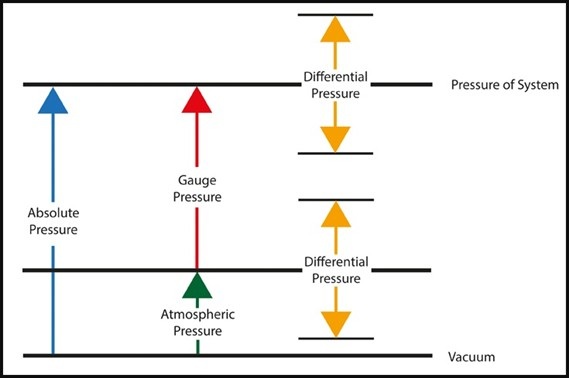
Like many variables, pressure can be measured and expressed in a range of different units. A preference for particular units can be determined by a number of factors including location, application type and the instruments being used:
- Pascal (Pa) is the SI (International System of Units) unit of pressure. One Pa is equal to one newton per square metre (N/m2). One kilopascal (kPa) is equal to 1,000 Pa.
- Pounds per Square Inch (psi) is an imperial pressure unit common in the USA. One psi is equal to the pressure from the force of one pound applied to an area of one square inch, or just under 6.895 kPa.
- Bar (bar) is common in industrial and meteorological applications. One bar is equal to 100 kPa or just over 14.5psi.
- Atmosphere (atm) is approximately equal to the average atmospheric pressure at sea level, which is 101,325 Pa or just under 14.7psi.
- Torr (torr) is common in engineering, medicine and science, and often used in vacuum applications. One torr is equal to 133.322 Pa or 1/760 of one atm.
- Millimeters of Mercury (mmHg) is often used as an alternative to torr, with one mmHg almost exactly equal to one torr. mmHg is used in medicine to measure blood pressure and like torr, is also found in vacuum applications.
- Inches of Mercury (inHg) is common in aviation and meteorology in the USA. One inHg is equal to 3,386 Pascals or just over 1/30 of one atm.
3. Inside a Digital Pressure Gauge
Digital pressure gauges use pressure-sensing transducers to convert applied pressure into an electrical signal. A microprocessor processes this signal and displays the measurement as a precise numerical value on a digital screen.
Most gauges use piezoresistive sensors, where pressure deflects an internal diaphragm and changes electrical resistance. This change is measured by the electronics and translated into an accurate pressure reading.
Digital LCD or LED displays eliminate parallax error entirely and provide clear readability, including backlighting for low-visibility environments. Without analogue dial limitations, digital gauges offer significantly improved accuracy and resolution, often showing pressure fluctuations as fine as 0.01 kPa / 0.001psi / 0.0001 bar.
Key Functional Features
- Modern digital gauges offer features that extend far beyond simple pressure indication. Data logging allows users to capture pressure trends over time rather than relying on a single real-time reading. Connectivity options such as USB, Bluetooth and wireless enable remote monitoring via software or mobile apps.
- Additional capabilities include touchscreen colour displays, a choice of multiple standard or customised engineering units, high resistance to vibration and shock, advanced communication protocols such as HART or electrical inputs/outputs for integration into broader control systems.
4. Types of Digital Pressure Gauges
Ex-Rated / Hazardous Area Certified / Intrinsically Safe Gauges
(see our Intrinsically Safe and Ex Devices Buyers Guide for more information)
In hazardous areas where flammable gases, vapours or dusts are present, standard electrical devices can create ignition risks if their failure generates sparks or heat. Digital pressure gauges for these environments must be built and certified to strict safety standards, with intrinsic safety being one of the key protection methods that allows electronic instruments to operate safely. Transtek supplies the following high-performance intrinsically safe models:
- Crystal XP2i Digital Test Gauge: Intrinsically safe for use in zone 0 (gas) hazardous areas. The world’s most popular test gauge. An industry standard known for ruggedness, reliability, reference-grade accuracy and ease of use.
- Crystal XP3i Digital Test Gauge: Like the XP2i, the XP3i is also zone 0 (gas) intrinsically safe but offers higher accuracy, Bluetooth and extra features.
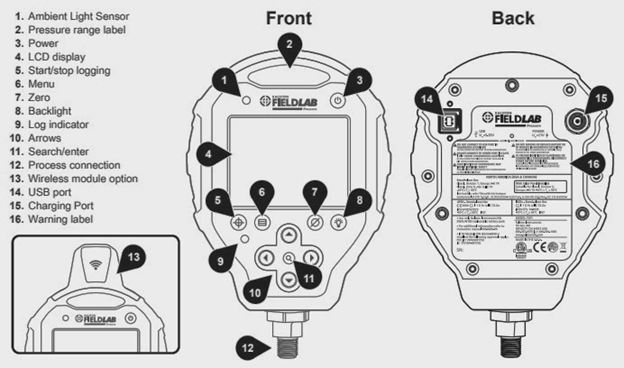
- Ralston FieldLab Digital Pressure Reference: Zone 0 (gas) intrinsically safe with test gauge accuracy. Excellent data logging and customisation with Ralston’s FieldLab app and desktop software.
Recorders / Data Logging Gauges
Many digital pressure gauges use an internal memory to save data points recorded at a defined frequency over a specified test period. Data logging flexibility can range from multiple samples per second over a few minutes on a benchtop to one sample every 24 hours over many months on a remote pipe line. Recorded data can be stored, viewed or downloaded to external software via USB, Bluetooth or wireless connections. Transtek’s range of digital pressure gauges provide multiple data logging and recording options:
- Crystal XP2i Digital Test Gauge: DataLoggerXP upgrade provides a 32,000 data point memory with USB connectivity. Desktop software with adjustable sample rates from 1 per second to every 18 hours.
- Crystal XP3i Digital Test Gauge: DataLoggerXP upgrade provides a 200 million data point memory with USB and Bluetooth connectivity. App-based remote control and cloud software. Adjustable sample rates from 5 per second to every 24 hours.
- Ralston FieldLab Digital Pressure Reference: 2 million data point memory as standard with USB and wireless connectivity. App-based remote control and desktop software. Adjustable sample rates from 128 per second to every 24 hours.
- Ralston LC20 Digital Pressure Gauge: 870 data point memory as standard with USB and Bluetooth connectivity. App-based remote control and desktop software.
- Crystal nVision Reference Recorder: 1 million data point memory as standard with USB connectivity. 2 inputs with interchangeable pressure, temperature or electrical modules. Real-time graphical data streams. Adjustable sample rates from 10 per second to every hour.
Test Gauges
Australian standard AS 1349:1986 specifies a required accuracy of +/- 0.25% of the full scale range for analogue / mechanical Bourdon tube pressure and vacuum test gauges. However, at the time of writing, there is no current Australian standard to specify the requirements of a digital test gauge for pressure measurement.
In the absence of relevant local standards, digital gauge manufacturers often state compliance with American standard ASME B40.7. This provides an “accuracy grade” ranging from B (lowest - commercial gauge) to 5A (highest - laboratory precision test gauge) according to a digital gauge’s “permissible error”. ASME B40.7 classifies digital test gauges as follows:
- 5A (laboratory precision test gauge) +/- 0.05% of span permissible error
- 5AR (laboratory precision test gauge) +/- 0.05% of reading permissible error
- 4A (laboratory precision test gauge) +/- 0.1% of span permissible error
- 4AR (laboratory precision test gauge) +/- 0.1% of reading permissible error
- 3A (test gauge) +/- 0.25% of span permissible error
- 3AR (test gauge) +/- 0.25% of reading permissible error
Transtek’s range of digital test gauges and data loggers provides portable precision reference accuracy out in the field:
- Crystal nVision Reference Recorder: Laboratory precision test gauge accuracy of up to 0.025% of reading.
- Crystal XP3i Digital Test Gauge: Multiple laboratory precision test gauge accuracy options - 0.02% of full scale, 0.05% of full scale or 0.05% of reading.
- Crystal XP2i Digital Test Gauge: Multiple laboratory precision test gauge accuracy options - 0.02% of full scale, 0.05% of full scale or 0.1% of reading.
- Ralston FieldLab Digital Pressure Reference: Laboratory precision test gauge accuracy of 0.1% of reading.
- Ralston LC20 Digital Pressure Gauge: Test gauge accuracy of 0.1% of full scale.
- Crystal M1 Digital Pressure Gauge: Test gauge accuracy of 0.2% of reading.
- Ralston LC10 Digital Pressure Gauge: Test gauge accuracy of 0.25% of full scale.
Differential / Dual Pressure Gauges
A differential pressure gauge provides connections for two pressure sources. This allows the user to simultaneously measure the difference between two separate test points (eg. across high and low sides of an orifice plate or filter) using only one device. Differential pressure gauges help reduce equipment costs and save valuable time in the field.
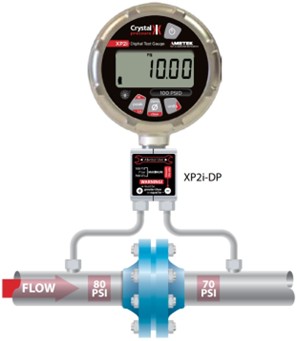
The Crystal XP2i-DP Differential Test Gauge is a zone 0 (gas) intrinsically safe device that enables differential pressure testing with laboratory precision test gauge accuracy of 0.1% of reading. Unlike most digital pressure gauges, the XP2i-DP is also designed for continuous, high precision vacuum measurement.
The Crystal nVision Reference Recorder is also certified as intrinsically safe for use in zone 0 (gas) hazardous areas. Interchangeable modules provide differential pressure measurement ranges from 3 to 1,000 bar with reference grade uncertainty of up to 0.025% of reading.
Intrinsically Safe Digital Pressure Gauges: Essential for Hazardous Environments
In industries like oil and gas, mining and chemical processing, potentially flammable gases or dust can create explosive atmospheres. In these hazardous locations, standard electronic equipment can act as a source of ignition. This is where intrinsically safe digital pressure gauges become crucial.
What is Intrinsic Safety?
Intrinsic safety is a protection method that limits the electrical energy in a system to a level that cannot cause ignition, even under fault conditions. Intrinsically safe digital pressure gauges are designed to operate safely in hazardous environments by limiting the electrical energy in the gauge and its connected circuits.
Why are Intrinsically Safe Gauges Important?
- Prevent Explosions: They prevent explosions by eliminating potential ignition sources.
- Protect Personnel: They protect workers from the risks of explosions and fires.
- Ensure Compliance: They are essential for complying with safety regulations in hazardous locations.
Key Features of Intrinsically Safe Gauges:
- Certified for Hazardous Locations: They are certified by recognised authorities (e.g., ATEX, IECEx) for use in specific hazardous zones.
- Low Power Consumption: They are designed to operate with minimal electrical energy.
- Encapsulated Electronics: Electronic components are often encapsulated to prevent the ingress of flammable gases or dust.
- Robust Construction: They are typically designed to withstand harsh environments and extreme conditions.
Examples of High-Performance Digital Pressure Gauges:
- Crystal XP2i: Known for its ruggedness, accuracy and ease of use, the XP2i is the world’s most popular test gauge and a regular choice for industrial applications. It is certified as intrinsically safe for use in zone 0 (gas) hazardous areas.
- Crystal XP3i: Building on the XP2i, the XP3i offers higher accuracy and additional features. It is also certified as intrinsically safe for use in zone 0 (gas) hazardous areas.
- Crystal M1: The M1 shares the same robust sensor technology as the XP2i but in a more affordable, compact package. It is an excellent choice for general testing and maintenance where intrinsic safety is not required.
- Ralston FieldLab: A reference-grade, intrinsically safe digital gauge with features including data logging and wireless connectivity, making it ideal for hazardous area pressure testing and calibration.
- Ralston LC10 & LC20: The LC10 is an affordable yet feature-rich digital gauge with customisable units and USB connectivity. The LC20 is a high accuracy portable gauge offering reliable laboratory grade uncertainty in the field.
Key Considerations for Buyers
1. Datalogging
Datalogging is a crucial feature for applications requiring pressure monitoring over time, such as leak testing, long-term process monitoring or troubleshooting intermittent issues.
How it Works: Digital gauges and dedicated recorders with datalogging capabilities can record pressure readings at user-defined intervals and store them in internal memory. The data can then be downloaded via USB or wireless connection for analysis.
Product References:
- Crystal nVision: The nVision is a versatile, intrinsically safe reference data recorder. It will log up to 1 million data points from two separate pressure, temperature or electrical input modules, offering real-time graphing on a large display. Its hand-held, rugged design makes it a powerful replacement for bulky, analogue chart recorders.
- Ralston FieldLab: Designed specifically for recording, calibration and testing, FieldLab software provides advanced logging functionality with digital records of tolerances and data sets for pass/fail determinations.
- Crystal XP2i & XP3i: Offer easy to use extended data logging capabilities, ideal for hydrostatic pressure testing and monitoring.
- Ralston LC20: Provides data logging and live viewing of pressure via USB or Bluetooth.
2. Intrinsic Safety
Intrinsically safe (IS) equipment is manufactured and certified for use in hazardous industrial areas where potentially flammable gases, vapours or dust may be present. By preventing the generation of sparks or excessive heat that could serve as the ignition source of an explosion, intrinsically safe digital pressure gauges and other devices operate safely and reliably in these challenging environments.
How it Works: Intrinsically safe pressure gauges are certified by international standards (e.g., ATEX, IECEx) to ensure their energy output is too low to cause ignition in a hazardous atmosphere.
3. Gauge Accuracy
Gauge accuracy is a measure of how close the displayed pressure reading is to the true pressure being applied to the sensor. Accuracy or uncertainty is typically expressed as a percentage of the gauge’s full-scale range (eg. 0.25% FS) or as a percentage of the reading displayed (eg. 0.1% RDG).
Analogue Gauges: Dial sizes, figure intervals and scale graduations contribute to the resolution and reading accuracy of all analogue / mechanical pressure gauges. Generally less accurate than digital gauges, full scale uncertainties of between 1% and 3% are commonly provided.
Digital Gauges: Generally offer superior accuracy and greater resolution. The Crystal nVision provides deadweight tester-level precision accuracy of up to 0.025% of reading. High-end gauges like the Crystal XP2i (0.02% of full scale) and XP3i (0.05% of reading) offer reference-grade precision. The Crystal M1 provides deadweight tester-level precision of 0.2% of reading, making it a highly reliable and cost-effective alternative to a full-scale device. The Ralston LC10 has a full scale accuracy of 0.25%, while the Ralston LC20 increases this to 0.1% precision test gauge standards.
4. Calibration
Calibration is the process of verifying a gauge's accuracy against a known, more accurate reference standard. Regular calibration is vital to ensure compliance with relevant standards and reliable measurements over time.
Digital Gauges for Calibration: Digital gauges with high accuracy are often used as calibration standards for other gauges.
Key Products:
- Crystal XP2i & XP3i: These test gauges are designed and commonly used for calibration of less accurate devices, combining laboratory reference grade uncertainty with excellent stability, repeatability and linearity.
- Ralston FieldLab: A comprehensive field calibration tool and software platform that removes the need for manual calculations by providing a digital record of data for certificates.
- Crystal nVision: With deadweight tester-level accuracy and advanced datalogging capabilities, the nVision is an excellent tool for high precision field calibration and verification.
By considering these key factors and referencing the specific products available from Transtek.com.au, you can confidently select the ideal pressure gauge or recorder to meet the unique demands of your industrial or enterprise application.
Choosing the Right Pressure Gauge
Linking Gauge Selection to Operational KPIs
Choosing the right pressure gauge impacts core KPIs such as uptime, safety, quality and efficiency. A well-matched gauge keeps systems within tolerance, reduces unplanned maintenance and supports compliance.
Choosing for Environment, Not Just Accuracy
Real-world selection often hinges on environmental factors rather than specs alone. Temperature extremes, vibration, chemical exposure, washdown requirements and hazardous-area classifications should guide your choice.
Application Criticality and Risk Profile
Different applications carry different risk levels. High-risk systems (gas networks or safety loops) require rugged gauges that remain stable under faults or pressure spikes, while low-risk utilities can use simpler devices. This risk-based decision lens is new and helps avoid under- or over-specifying equipment.
Digital vs Analogue Through Lifecycle Cost
The earlier sections compare features, but not cost over time. Analogue gauges are cheaper upfront but often cost more through frequent calibration requirements, misreads and mechanical wear. Digital gauges deliver lower lifecycle cost in harsh or high-duty environments.
Matching the gauge to your environment, risk level and operational needs delivers long-term reliability. For tailored guidance and the right gauge for your environment, speak with Transtek’s technical team.

Proudly providing specialist equipment and customised solutions to industries throughout Australasia since 1998. 100% family-owned in Western Australia.

Our customers are the centre of our universe. Our unmatched experience, knowledge and expertise builds trust and ensures we provide the support you need.

Reliable products from the most established and respected brands in the business. Cutting edge technologies bringing innovative solutions to real world problems.