********* FREE SHIPPING on TORCHES & LIGHTING >$175 *********

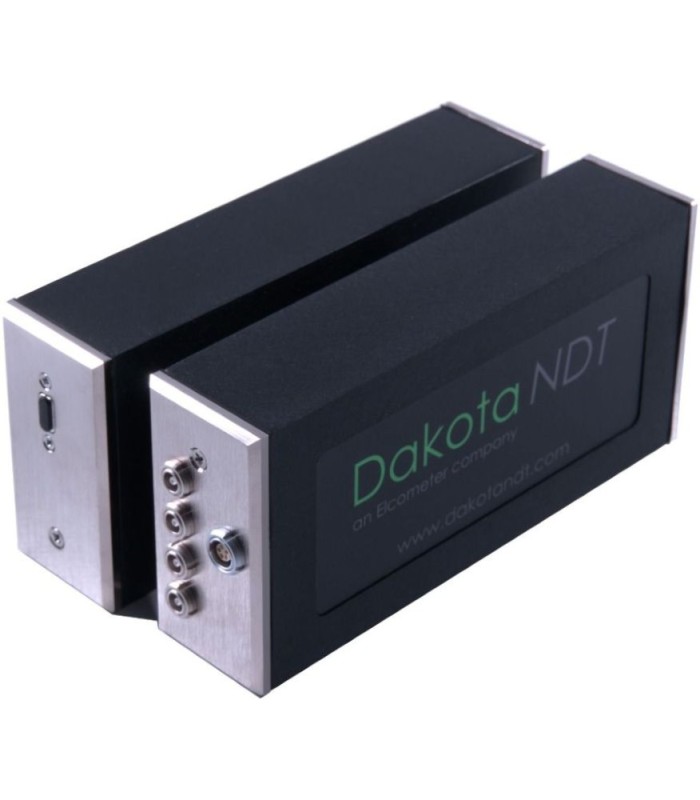
Dakota MultiMax 4 Channel Bolt Tension Monitor
| Manufacturer | DAKOTA NDT |
| Features |
|
| Includes |
|
| Manufacturer Model | MultiMax |
| Warranty | 2 years limited |
Transducer not included as standard
See options below
Single element
Single element
Single element
Require separate pin contact probe transducer for activation and measurement
Designed for keyholes, recesses, raised areas, embossed markings, small diameters, etc.
Designed for permanent fixed installation
Compatible with Loctite 425 adhesive / 76820 X-NMS solvent or equivalent
Single element
Operates with automatic temperature compensation
Accounts for thermal expansion / contraction and material velocity changes
Maintains accuracy across different operating conditions
Includes 1.8m / 6ft cable with 5-pin Lemo connector
Dakota MultiMax 4 Channel Bolt Tension Monitor
| Manufacturer | DAKOTA NDT |
| Features |
|
| Includes |
|
| Manufacturer Model | MultiMax |
| Warranty | 2 years limited |
Trade Customers
Login for your specific pricing.
Queries or Big Orders?
0 in Stock (Available for Order)
 Overnight Delivery Australia Wide*
Stocked items are dispatched daily with express overnight shipping to most areas.
-
Trade Pricing & Price Match Guarantee
Wholesale/resale and large quantity volume discounts are available. Contact us.
-
Emergency Services, Fire, Rescue, Defence or Government?
Contact us for special discounts for Australian fire & rescue, EMS and govt depts.
-
Buy Local. We're Australians Too!
Transtek has been a proud family-owned Australian business since 1998.

The Dakota MultiMax is a cutting-edge 4-channel ultrasonic bolt tension monitoring system with remote access.
Suited to automotive, aerospace, energy, construction and manufacturing industries, the MultiMax delivers precise, real-time stretch, load, stress, strain and temperature measurements that are visible from anywhere in the world.
Precision accuracy to 0.0001mm and continuous real-time information provide valuable insight into the status of your critical bolted joints, whenever you need it and wherever you're located.
The MultiMax seamlessly integrates into existing systems with Dakota's MultiUI software, enabling efficient real-time condition monitoring of fastener elongation, simplifying proactive maintenance and preventing failures.
The MultiMax system is also expandable and scalable with each module able to monitor up to 4 bolts; providing a comprehensive and reliable centralised solution for large scale operations such as pipelines, wind turbines, factories and processing plants.
Modules can be stacked and controlled remotely or locally to simultaneously monitor and configure hundreds of independent channels via a single interface.
Magnetic and glue-on transducers are available for secure placement and permanent installation.
Ultrasonic Bolt Tension Monitoring
The MultiMax operates with up to four transducers that send an ultrasonic pulse into one end of each bolt being tested.
This pulse reflects off the other side of the bolt and returns to the transducer, allowing the overall length of the bolt to be calculated from the time-of-flight (TOF) between initial pulse and return echo.
Friction-Independent Measurement
The Dakota MultiMax directly measures the elongation of the bolt, allowing for accurate tension assessment without the need to explicitly consider or address frictional effects.
Using ultrasonics, the MultiMax is not affected by the temperature, friction or resistance factors commonly encountered in standard torque measurement techniques.
This friction-independent measurement method simplifies the tensioning process and minimises the main source of tensioning error.
Automatic Temperature Compensation
Bolt tension is sensitive to temperature changes, which affect the thermal expansion and contraction of the components.
Unlike torque wrenches, the MultiMax addresses this issue with automatic temperature compensation and an optional external temperature sensor.
This feature allows the MultiMax to adjust the measured elongation to account for temperature fluctuations, ensuring accurate and consistent tension measurements across different operating conditions.
Traceability and Auditability
As part of Dakota's bolt tension systems, the MultiMax offers a significantly higher level of traceability and auditability when compared to torque wrenches.
The MultiMax system incorporates advanced data logging capabilities that record precise measurements, environmental conditions and other relevant parameters.
This detailed data can be used for traceability purposes, enabling the tracking of tension values over time and ensuring compliance with quality standards.
The data also enhances the auditability of the bolted connections, facilitating analysis, verification and validation of the tensioning process.
Increased Range and Enhanced Accuracy
The MultiMax is compatible with a huge range of bolt sizes from 25.4mm / 1 inch to 15.2m / 50 feet and features precision accuracy to within 0.0001mm / 0.00001 inch.
Data Logging and MultiUI Software
Each MultiMax module provides 4GB of internal SD memory for storing measurement data.
Adjustable sample rates allow data to be logged at frequencies from six times per minute to once per month.
Data is automatically archived after every 8,000 samples to ensure uninterrupted continuous recording.
Dakota's MultiUI software enables local or remote configuration and management of one or multiple MultiMax modules.
MultiUI provides a fixed or mobile control panel to monitor waveforms for precise set-ups; view real-time information from connected modules and channels; and record, analyse and transfer data.
USB Line Power
A USB-C port enables a permanent USB or AC power connection for continuous use.
Environmental Specifications and Certifications
The rugged MultiMax has a wide operating temperature range of -10 to +60°C / 14 to 140°F.
An IP65 rated dustproof and waterproof housing withstands use and abuse in extreme environments and heavy duty, industrial workplaces.
An extruded aluminum body with gasket-sealed nickel-plated aluminum end caps easily copes with everyday wear and tear.
The MultiMax is also factory calibrated traceable to NIST and certified to military standard MIL-STD-45662A.
Physical Specifications
Compact, portable and lightweight, the MultiMax measures 76 x 165 x 38mm and weighs only 454g.
Features Include:
- Measurement options including stretch / elongation, time (nanoseconds), load, stress, %strain
- Real-time remote control and data from individual modules and channels
- 4GB internal data logging memory with auto-archiving for continuous monitoring
- Scaleable and expandable for applications with a large number of critical bolt tension points
- Pulse-echo (PE- standard) measurement mode
- Display options including RF (full waveform view) and large digits
- Repeatability / stability indicator to confirm consistency of readings
- Pre-set or customised material types and material velocities
- Adjustable gates, gain, pulse width, pulser voltage, damping and digitizer values
- Automated detection, scope and display setting process for each bolt
Bolt Tension Monitoring FAQs
What is bolt tension?
Bolt tension refers to the force or stress applied to a bolt to secure two or more components together.
When a bolt is tightened, it elongates and creates tension within the bolt and the connected components.
This tension generates a clamping force, also known as the preload, which holds the components in place.
It helps to think of a bolt as a very stiff spring, that when stretched out acts to pull the two parts together.
What is ultrasonic bolt tension monitoring?
Ultrasonic bolt tension monitoring is a non-destructive testing technique used to measure the length/elongation of a bolt under tension.
A transducer sends an ultrasonic pulse into one end of the bolt being tested.
This pulse reflects off the other side of the bolt and returns to the transducer, allowing the overall length of the bolt to be calculated from the time-of-flight (TOF) between initial pulse and return echo.
From any elongation value measured, the operator can derive values for bolt tension, stress and strain.
Ultrasonic measurements also avoid the difficulties associated with accurately assessing the magnitude of frictional forces.
Why is bolt tension important?
An appropriate level of tension is crucial for ensuring the integrity and reliability of the bolted joint.
Sufficient tension is necessary to prevent the connection from loosening due to external forces, vibrations or thermal expansion/contraction.
However, bolts should not simply be driven to maximum torque every time.
Excessive tension can lead to bolt failure or damage to the components so in many sitiations, appropriate and accurate tension is critically important.
How do technicians ensure target tension?
Target tension is typically achieved by torqueing the bolt or applying a specified preload using a calibrated tensioning device.
The tension is often expressed as a percentage of the bolt’s yield strength or as a specific load value, with most applications aiming for 75-90% of the bolt’s yield strength - a point known as the "proof load".
The most common bolt tensioning device is the torque wrench, but simple wrenches, hydraulic drivers, load-sensing bolts and ultrasonic measurement devices are often used in combination to achieve the correct or target tension.
Are torque and tension equivalent?
No. One of the easiest ways to think about the relationship between torque and tension is in terms of applied force and resultant force.
Torque is the twisting force applied to the bolt or fastener.
Tension is the resultant force of this tightening procedure.
As a result of the frictional forces that act on the bolt’s surface, not all input torque is converted to resultant bolt tension.
What are the limitations of torque wrenches?
If reliably calibrated and of sufficiently high-quality, a torque wrench can provide a preload uncertainty of ±25%.
The main source of this inaccuracy comes from the difficulty of measuring the force of friction that opposes the bolt’s rotation.
Frictional forces are difficult to measure because many factors affect their magnitude.
The equation F =T/kD is often used to estimate how much torque is required to reach a specific preload figure.
F is the load, T is the torque, k is the ‘nut factor’ that encompasses the frictional resistance and D is the diameter of the bolt.
The value of k is often standardised as 0.2 but in reality it can vary greatly depending on the environment.
DOWNLOADS
Loading Accessories and Related Products...

Proudly providing specialist equipment and customised solutions to industries throughout Australasia since 1998. 100% family-owned in Western Australia.

Our customers are the centre of our universe. Our unmatched experience, knowledge and expertise builds trust and ensures we provide the support you need.

Reliable products from the most established and respected brands in the business. Cutting edge technologies bringing innovative solutions to real world problems.